
Jane Street sharply reduced its Bitcoin ETF exposure in the first quarter of 2026, reducing holdings in BlackRock’s IBIT and Fidelity’s FBTC while increasing positions in Ether ETFs and several crypto-related stocks. The move revived speculation that one of the market’s largest trading firms may have been a major force in Bitcoin’s recent price dynamics — and that the smaller reported position could remove a key advantage for BTC.
According to the latest 13F filings, Jane Street reduced its IBIT position by approximately 71% and its FBTC position by approximately 60% in the first quarter. Parker White, Chief Operating Officer (COO) and Chief Investment Officer (CIO) of DeFi Development Corp (DFDV), renewed his thesis from February and claimed via X that the filing could help answer questions that have been circulating since the massive IBIT trading disruption on February 5th when the price of BTC saw a massive -18% drop.
“It is now apparent that Jane Street reduced their IBIT and FBTC holdings by approximately 70% in the first quarter based on 13F filings,” Parker wrote on X. “Did they just sell outright or more likely, did they make a HUGE profit on their short derivatives, which they don’t have to report? We are still waiting for the last shoe to drop with one of the likely culprits of the explosion.”
It is now apparent that Jane Street reduced its IBIT and FBTC holdings by roughly 70% in the first quarter based on 13F filings. Did they just sell outright, or more likely, did they make a HUGE profit on their short derivatives (which they don’t have to report)?
We are still waiting for… https://t.co/67XxlwZEGm
— Parker (@TheOtherParker_) May 13, 2026
Related reading
Will the price of Bitcoin rise now?
The filing does not show exposure to Jane Street derivatives, nor does it determine whether the firm was bearish, hedged or engaged in ETF arbitrage and market-making activities. This limitation is central to the discussion. The 13F includes certain long-term holdings at quarter-end, but does not provide a complete overview of options, swaps, futures or short exposures that could significantly change the economic interpretation of reported reductions.
Still, the reduction became a focal point due to earlier claims that Bitcoin’s price discovery may have been skewed by the mechanics of spot ETF trading. Bitwise advisor Jeff Park wrote that Jane Street “reduced its exposure to the Bitcoin ETF in the first quarter of 2026,” reducing IBIT by approximately 71% and FBTC by approximately 60%, before adding, “Price discovery is back on the menu.”
Park’s broader argument is not that a single company has explicitly suppressed the price of Bitcoin, but that the ETF structure creates a complex market-making environment in which authorized participants can use creation and redemption mechanics, derivatives, and futures hedging in ways that can weaken the link between ETF demand and spot purchases of Bitcoin. In a previous post, he described the issue as structural, not conspiratorial.
JANE STREET DECREASED ITS BITCOIN ETF EXPOSURE IN Q1 2026, DECREASING IBIT BY ~71% AND FBTC BY ~60%, ACCORDING TO LATEST 13F FILING
Price disclosure is back on the menu https://t.co/ed41KhlQC4
— Jeff Park (@dgt10011) May 13, 2026
“The short answer is that no AP explicitly suppresses the price of Bitcoin,” Park wrote. “What the AP structure can suppress is the integrity of the price discovery mechanism itself. They are not the same thing – but the latter is arguably more consistent than the former.”
Related reading
This difference is important for bullish interpretation. If Jane Street’s reported Bitcoin ETF exposure has already been significantly reduced, some traders might read the filing as evidence that a major source of ETF-related pressure has been partially removed. Parker went further, suggesting that Jane Street “probably doesn’t want to be short BTC forever” and that observers should “look for them to start accumulating again in Q2.”
The thesis is speculative, but not without clear market logic. If a major trading firm was involved in strategies that put sustained pressure on ETFs or derivatives, the reduction in reported Bitcoin ETF holdings, combined with any eventual unwinding of related positions, could shift the market balance back toward pure spot-led price discovery. That’s the bullish setup implied by the posts: not only did Jane Street sell, but the trade may have already played out.
At the same time, Jane Street has not broadly abandoned crypto exposure. The firm increased stakes in the BlackRock and Fidelity Ether ETFs and added positions in Riot Platforms, Coinbase and Galaxy Digital, while cutting Strategy and several Bitcoin mining names.
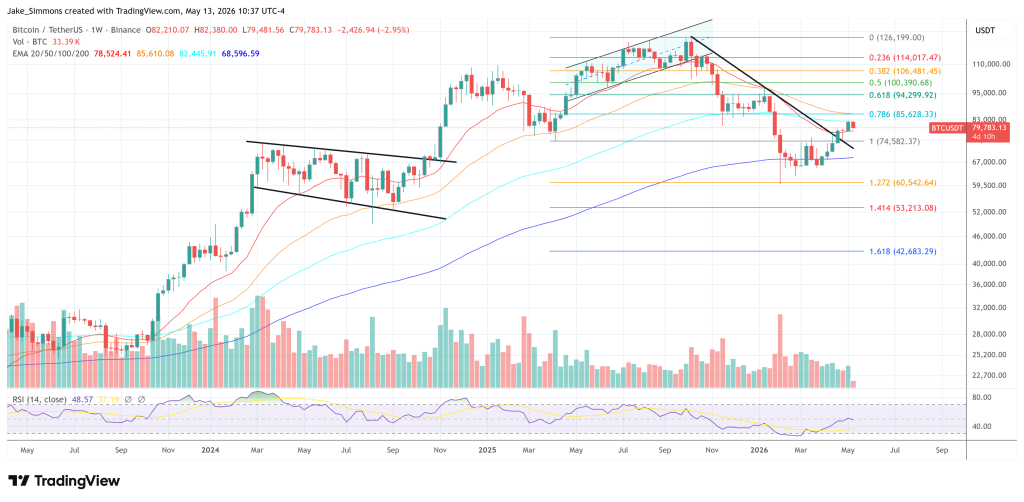
At press time, BTC was trading at $79,783.
Featured image created with DALL.E, chart from TradingView.com