Bitcoin currently exhibits a structure that often precedes sharp volatility, with liquidity increasing above key levels while price consolidates below. This type of setup usually signals that the market may first go hunting for those liquidity zones before establishing the next clear directional trend.
Bitcoin is building a liquidity cluster around the $80k zone
Crypto analyst Cryptorphic recorded that Bitcoin is once again building a dense cluster of liquidity around the $80,000 level. This area is becoming increasingly important, as leveraged positions continue to rally above the current price action, creating a potential target zone for the market.
Currently, Bitcoin is trading below this pocket of liquidity and moving within a relatively tight range, reflecting indecision in the market, where the price is consolidating before a larger expansion. Historically, similar setups have often led to a drop in liquidity as the market searches for areas of unfilled orders.
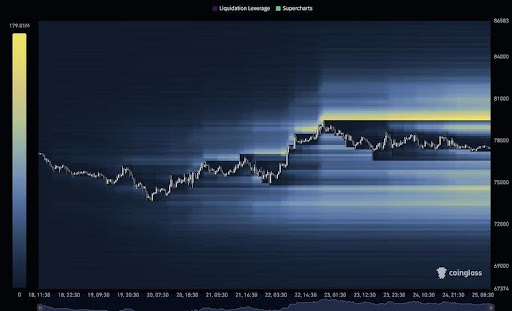
These liquidity zones tend to act like magnets, pulling price towards them as stop-loss and liquidation points accumulate. With so much interest positioned around $80,000, increased liquidity becomes a natural goal if momentum shifts even slightly in favor of buyers. The broader implication is that Bitcoin may first try to sweep this $80,000 zone or reach that liquidity level and react from there before any sustained direction becomes clear.
Markets move in two distinct phases
According to analyst Mags, the market goes through two different phases. The first is the Bull Phase, Mags emphasizes that although the primary trend is up, it is never a straight line to the top. Instead, price action is characterized by multiple pullbacks, often in the 20% to 30% range, that occur before the cycle peak is reached. These corrections are not presented as threats, but as a normal and necessary part of any cycle journey, feeling rested and recharging.
The second phase identified by Mags is the bear phase, which is triggered when the underlying market structure finally breaks. This shift leads to a much deeper correction than the standard pullbacks seen during ascent. During this period, the market goes through the process of finding a final bottom, clearing the stage for the start of the next trend.
Ultimately, Mags argues that while the phases change, it is the presence of volatility that never changes. The difference between success and failure lies in the ability to recognize your current position within the cycle. As Mags points out, history has consistently rewarded those who can ignore the noise of short-term change and focus on the long-term game, recognizing that each stage is simply part of the market’s natural rhythm.