Bitcoin has fallen below the $90,000 level as markets react to rising macroeconomic tension between the United States and the European Union, along with new concerns related to geopolitical friction over Greenland. The renewed de-risking tone has pressured stocks and cryptocurrencies alike, heightening Bitcoin’s sensitivity to global headlines as uncertainty rises and investors cut exposure to high-beta assets.
Related reading
Beyond the price action, on-chain data suggests a deeper shift is occurring within the Bitcoin market. A report by analyst MorenoDV highlights that, for the first time in history, “new whales” now account for a larger share of Realized Cap Bitcoin than long-term “OG” whales. Realized Cap tracks the aggregate cost base of coins based on their most recent movement on the chain, meaning this change signals that a significant portion of the BTC supply has recently changed hands at higher prices.

This transmission of influence is important because it reshapes short-term supply dynamics. When the newer large holders dominate realized capital, market behavior can become more reactive, with marginal supply increasingly controlled by investors who entered later in the cycle and may be more sensitive to volatility. As Bitcoin struggles to return to $90,000, this evolving whale structure may help explain why returns feel less stable and why selling pressure can quickly re-emerge during macro-triggered pullbacks.
The new whales are now dictating the short-term direction of Bitcoin
Realized Cap measures the aggregate cost base of Bitcoin by valuing coins at the price of their last movement on the chain. When this metric moves toward new whales—short-term owner whales holding more than 1,000 BTC with UTXO ages under 155 days—it signals that a significant portion of the supply has recently changed hands at elevated prices. In other words, market control is moving away from seasoned, cycle-tested holders toward late-trending capital.
This transition helps explain Bitcoin’s current behavior. The realized price of new whales is close to $98,000, while the spot price continues to trade below that level. As a result, this cohort is estimated to carry approximately $6 billion in unrealized losses. These losses are not just a paper drop – they shape decision making and increase sensitivity to volatility, especially during sharp corrections.

Data on realized PnL in the chain suggests that since the peak of the market, new whales have caused most of the realized losses. During the recent decline, they repeatedly sold on weakness and used short bounces to exit positions. A reflection of risk management, not belief.
Old whales tell the opposite story. With a realized price of around $40,000, long term whales remain very profitable. Their activity was limited in relation to the flow of new whales. For now, Bitcoin’s direction is dictated by this newer, more fragile cohort of whales.
Related reading
Bitcoin breaks below key support
Bitcoin is again showing weakness after losing the psychological level of $90,000 and the price is now hovering near $88,300 on the daily chart. The structure reflects a clear downtrend from the late 2025 highs, followed by a failed recovery attempt. After a sharp drop in November, BTC stabilized and built a short base of consolidation, but the rally in early January lacked continuation and quickly turned into another bounce.
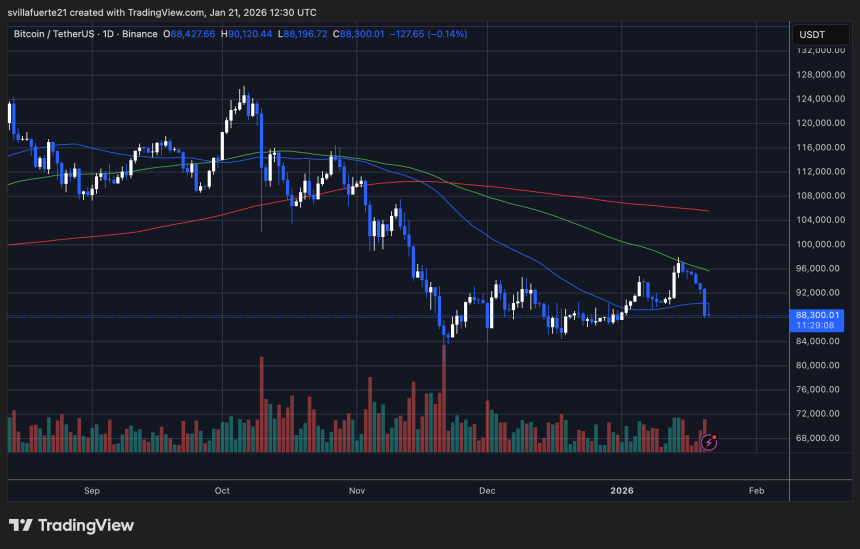
From a technical perspective, BTC remains trapped below its major moving averages, which now act as dynamic resistance. The short-term average has reversed sharply, while the broader trend line above continues to move down. Signaling that momentum remains limited, with sellers still controlling gains. The recent jump towards the mid-$90K region has been aggressively rejected, confirming that overall supply remains strong and that buyers are not yet strong enough to reverse the trend.
Related reading
Volume patterns support this story. The biggest jumps occurred during the selloff, showing forced activity and distribution. While the latest attempts at recovery have been met with weaker participation. As long as Bitcoin remains below the $90,000-$92,000 zone, the price action suggests that the market is still looking for a stable bottom. The downside risk remains elevated if fear accelerates in the broader crypto market.
Featured image from ChatGPT, chart from TradingView.com