In a post on X on October 29, Quinn Thompson, CIO of Lekker Capital, argued that Jerome Powell’s post-FOMC messages were less about macro uncertainty and more about pressure tactics aimed at the political apparatus — with direct consequences for crypto liquidity.
Powell’s FOMC comments decoded
Thompson wrote: “Powell appeared to be playing political games/posturing/CYA around the December phrase, presumably to communicate with the admin to reopen the government. It almost seemed like a threat that if there was no data (due to the continued government shutdown), then there would be no cuts in December and the market was briefly rejected by that uncertainty.” He stressed that it was unusual to hear Powell comment directly on market expectations: “The immediate reaction made sense given that it is quite unusual to hear Powell comment so specifically on market prices because he always refrains from doing so and emphasizes that he will not comment on market prices.”
This is the core of Thompson’s reading. Powell had just broken his habit. Powell is inclined to reject any frameworks that imply the Fed confirms market prices in advance. This time, after the Federal Reserve cut its benchmark rate by 25 basis points to a target range of 3.75%–4.00%, Powell pointedly said that “further rate cuts at the December meeting are not a foregone conclusion — far from it.”
He pointed out that within the Committee there are “very different views” on the speed and depth of further concessions. The markets changed prices immediately. Treasury yields rose and the probability of a December cut plummeted from a near certainty to something closer to a coin toss, and risk assets reacted accordingly. That includes crypto: Bitcoin and large-cap crypto assets initially traded lower alongside stocks as the market read the comment as a sharp surprise rather than positioning.
Related reading
Thompson’s view is that this was not about signaling a hawkish turn. It was about signaling conditioning. He casts Powell’s remarks as a message to the White House and Congress: reopen the government, restore the flow of economic data and the Fed has cover to cut again in December; keep the shutdown in place and withhold official Fed data, and Powell can say, on the record, that he can’t justify further adjustment. Powell himself stressed that the central bank was operating “in the absence of key government data” as the shutdown that began on Oct. 1 blocked normal reporting on labor, inflation and activity. Thompson characterizes this attitude as an implicit warning shot.
According to him, “What you make of that is up to you, but other than that I believe the market may have been surprised by the Fed’s incorrect reaction to the government shutdown. There is no scenario where the economy is stronger because of the shutdown and if they highlight continued downside risks to the labor market, there is not a great case to deviate from the September plan.”
For crypto, the subtext is important: Thompson says Powell’s comments were not a signal to tighten financial conditions for the rest of the year. They were leverage in political negotiations, not the upper limit of liquidity policy.
That point is operational, not rhetorical. Thompson says the Fed’s stated logic isn’t really consistent with what the Fed itself claims to be concerned about. Powell’s justification for the Oct. 29 cut relied heavily on a softening labor market and downside risks to employment. The FOMC’s official statement pointed to a “shift in the balance of risks” toward weaker hiring, noted that job gains had slowed and acknowledged that unemployment had risen.
Powell also said inflation was still above target but was no longer accelerating the way it had earlier in the year, prompting some members to prioritize easing more quickly. That combination — weakening labor, slowing inflation, policy cuts — has historically been constructive for crypto because it points to easier dollar liquidity and a lower cost of capital without an outright crisis.
On the balance sheet, Thompson points to something that has already been documented in the Fed’s statements and press releases, but not yet fully assessed against risk: “Just a week or two ago, the market did not expect QT to end anytime soon, and today Powell went so far as to discuss the next step in this process which is a return to balance sheet growth. These developments are definitely liquidity positive, although MBS reinvestment and future purchases will be all or mostly bills.”
What this means for crypto
Simply put, the Fed didn’t just cut rates by 25 bps. It also said it would end quantitative tightening on December 1. This means the Fed will no longer allow its Treasuries and mortgage pools to passively shrink. Instead, it will reinvest maturing Treasuries back into Treasury bonds and divert principal payments from its portfolio of mortgage-backed securities into Treasury bills.
Related reading
For crypto, this is the line that matters. When the Fed stops shrinking its balance sheet and starts recycling into accounts again, it effectively injects incremental dollar liquidity into the system, even if it refuses to call it QE. That liquidity has historically trickled down to the parts of the market most susceptible to excess cash and scarcity of duration — technology, high-beta credit and crypto. What Thompson is really saying is that beneath the surface of Powell’s cautious language, the Fed has just signaled the start of the next crypto liquidity regime.
This is a critical liquidity inflection that’s easy to miss if the only headline you’re absorbing is “December taper not guaranteed.” A QT break this early was not the consensus two weeks ago. This is also why Thompson rejects the idea that Powell’s tone was structurally bearish on risk.
He writes: “All in all, I think a cut in December is still very likely.” He then lays out the macro sequence he expects to see after the shutdown ends: “Ultimately, I think they’re going to reopen the government in the next couple of weeks so there’s going to be data and it’s probably going to show that inflation is coming down for the next couple of months and the labor market is going to continue to weaken and Trump is making deals that are likely to lower tariffs, which also earns him points with the FOMC.” The message for crypto investors is that when data rebounds, it will justify continued easing, not block it.
The final part of Thompson’s post moves from mechanics to management. He points directly to Powell’s outstanding authority. “Powell’s term as chairman ends in 6 months, and his successor will be known even earlier, creating a situation in the shadow of the Fed chairman. It remains clear to everyone and the market that the new chairman will be friendly to the administration’s plan and will help in its implementation. Considering all the above, it is difficult for me to paint a case for carrying risk assets based on liquidity dynamics, because all signs point to the continuation of the massage to support the markets.” That’s the crypto point.
Thompson argues that the Fed’s institutional bias, going into the succession window, is geared toward maintaining and managing liquidity conditions so markets don’t burst. If that bias exists, it’s inherently crypto-bullish, as it implies a lower policy measure below dollar liquidity at the exact moment the Fed is already preparing to stem balance sheet outflows and expand again via bills.
At press time, the total capitalization of the crypto market was $3.73 trillion.
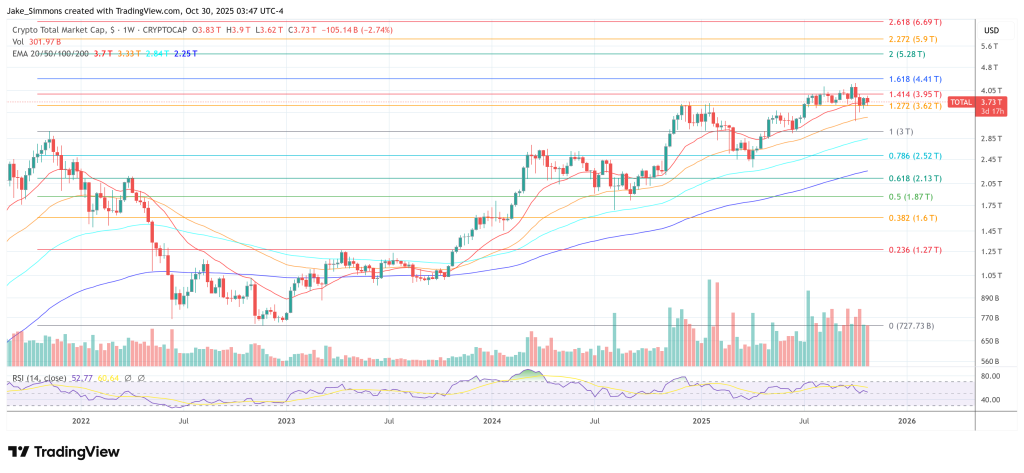
Featured image created with DALL.E, chart from TradingView.com