
Bitcoin’s (BTC) recent performance may be less about crypto market weakness and more about its position at the beginning of the risk curve. Asset management firm Bitwise said that BTC often acts as a “canary in the macro coal mine”, reacting to changes in liquidity and financial conditions before traditional markets. With stocks now showing similar signs of tension, the firm sees Bitcoin’s move as part of a broader adjustment to reduce risk.
Global liquidity and interest rates remain in focus: Bitwise
Important he said that Bitcoin and Ether hit cycle lows of $58,000 and $1,507 respectively, while other global risk assets faced mounting pressure. The Nasdaq posted its sharpest daily drop of 5% in months and South Korea’s KOSPI (Korea Composite Stock Index Price Index), its benchmark stock index, caused a temporary trading halt after a sharp sell-off led by semiconductor stocks.
The change followed stronger-than-expected U.S. labor market data, which reduced expectations for near-term easing by the Federal Reserve. Higher expectations for long-term interest rates kept US 10-year bond yields higher and weighed on growth-sensitive assets. The US 10-year yield held close to 4.53% on Tuesday after reaching 4.68% last month, the highest level of the year.
Bitwise pointed to a recurring pattern in which Bitcoin weakens months before stocks. Unlike traditional markets, BTC trades continuously and reacts quickly to changes in liquidity conditions.
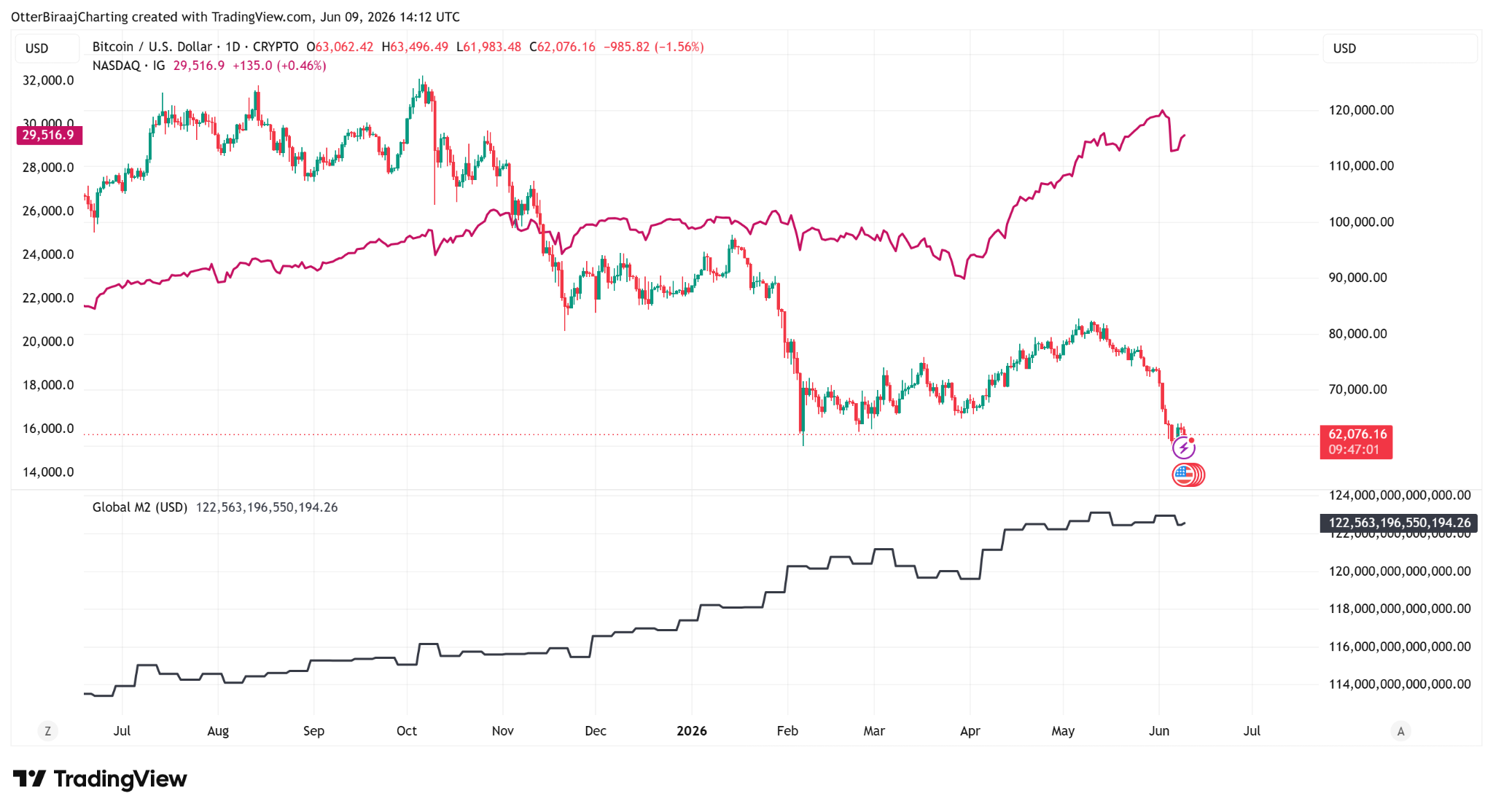
BTC Price, NASDAQ and Global M2 Liquidity. Source: Cointelegraph/TradingView
A chart comparing the liquidity of Bitcoin, Nasdaq and Global M2 highlights the discrepancy. Global M2 has climbed to roughly $122.6 trillion, a steady increase over the past year, while Bitcoin has bounced back from its highs of $126,000.
If Bitcoin is acting like a macro canary, its correction may be telling a different story than a simple risk-free move. BTC has already gone through a significant repricing as global liquidity continues to expand. This leaves open the possibility that Bitcoin is further along in the adjustment process than stocks, especially if liquidity conditions improve later in the cycle.
Related: Bitcoin price slips toward local lows of $62,000 as bear market history keeps repeating itself
Stablecoin reserves signal dry powder
Onchain data offers a different perspective on crypto market liquidity. Independent market analyst Maartunn highlighted that the relative strength index (RSI) of the Stablecoin Supply Ratio (SSR) fell to an oversold reading of 13.
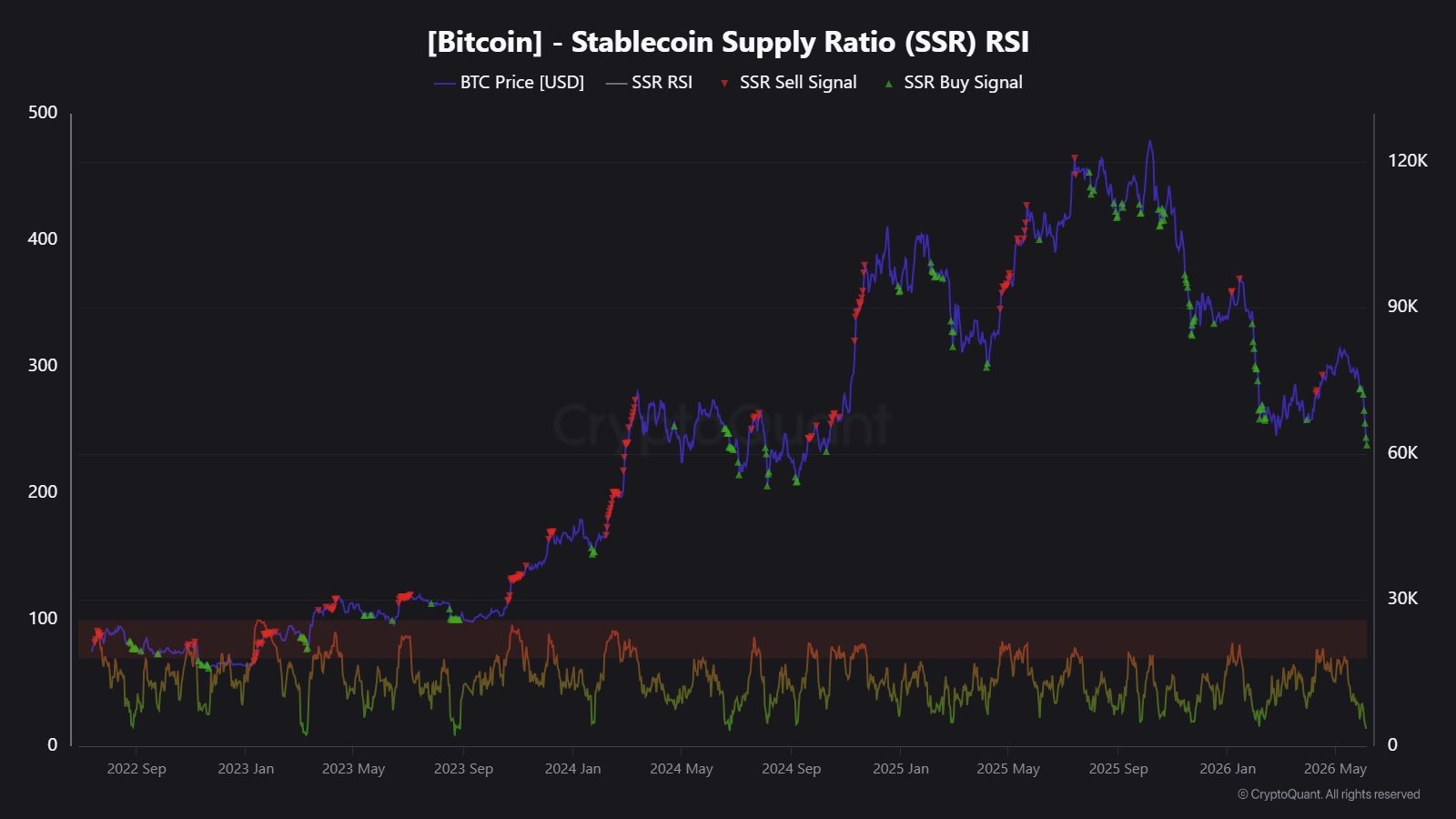
Stablecoin Supply Ratio (SSR) RSI. Source: CryptoQuant
SSR measures Bitcoin’s market cap against the market value of major stablecoins such as Tether’s USDt (USDT) and Circle’s USD Coin (USDC). Lower readings indicate higher stablecoin balances relative to Bitcoin’s valuation, indicating significant buying power sitting on the sidelines.
Historically, similar SSR RSI readings have appeared near accumulation zones and have been followed by periods of stronger price action once liquidity has returned to the market.
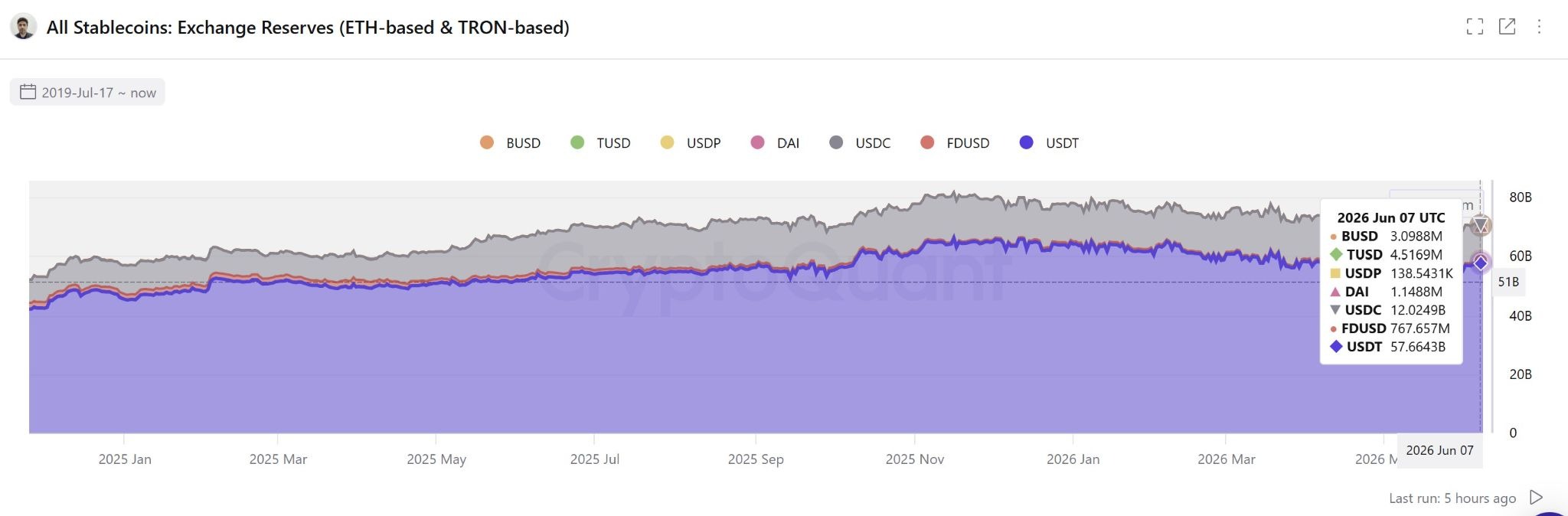
All stablecoin exchange reserves. Source: CryptoQuant
Data on foreign exchange reserves also indicate a substantial amount of liquidity. The combined reserves of major stablecoins on exchanges are currently close to $72 billion, led by $57.7 billion in USDT (USDT) and $12 billion in USDC. The total is down from late-2025 peaks above $80 billion, although balance sheets remain high by historical standards. This leaves a significant amount of capital positioned in exchanges as Bitcoin trades near the lower end of its recent $62,000 range.
Related: Bitcoin Bottom? These four charts indicate a drop in BTC price to $50k