Arthur Hayes says Maelstrom sold its entire Zcash position after new revelations about the Orchard Pool vulnerability sharpened the perceived risk around ZEC’s monetary integrity. The move effectively ends his recent “Holy Trinity” trade across ZEC, NEAR and HYPE, leaving Worldcoin as the AI-related bet he says the fund still holds.
“The Holy Trinity is Dead,” Hayes wrote on X. “Unfortunately, due to the exploitation of Orchard Pool, I had to throw away our entire ZEC bag.”
Why is Hayes ditching Zcash now?
The announcement follows a detailed statement from Zooko Wilcox, Jason McGee and Taylor Hornby, who described the issue as the “Orchard Counterfeit Vulnerability”. According to their summary, Hornby discovered a critical vulnerability in Zcash’s Orchard cluster on May 29 and disclosed it to the Zcash Open Development Lab, which then coordinated an emergency response completed on June 2. The bottom line was clear: the vulnerability “could be exploited to create an unlimited amount of counterfeit ZECs within Orchard.”
Related reading
That discovery changed the market landscape. Earlier messages from the ecosystem emphasized that the vulnerability had been remediated, that there was no evidence of exploitation, and that users’ funds remained safe. But Wilcox, McGee and Hornby he added an important caveat: due to Orchard’s privacy properties, there is no way to cryptographically prove whether the vulnerability was exploited while it existed. That difference is at the heart of Hayes’ decision to come out.
“While I think it is highly unlikely that a coinage will occur, it cannot formally be proven cryptographically impossible,” Hayes wrote. “Privacy from AI, government, the grand tech narrative demands perfection, not implausibility. I’ve been reading about exploitation to this day and I didn’t like how it messed with my narrative mental map.”
Josh Swihart, founder and CEO of Zcash Open Development Lab, offered his own explanation in a post titled “Never Again.” Orchard described the bug as a flaw in one of the system’s rules: the rule was written loosely enough that it could accept false information and still pass. In other words, the problem was not a privacy leak, but a correctness error in the proof system, the kind of problem that can undermine confidence in whether the creation of an invalid value was possible within a protected pool.
The emergency fix required coordinated network action, not a simple wallet or app patch. ZODL and the wider Zcash ecosystem temporarily disabled Orchard’s actions and then reinstated them with a patched circuit. The patch may have removed the vulnerability, but as far as the private asset is concerned, the reputational damage was due to the remaining uncertainty: no proof of forgery is the same as cryptographic proof that forgery never happened.
Related reading
Hayes said ZEC’s roughly 30% selloff had him reevaluating the position. “The 30% bounce made me rethink and I had to take profit on the entire position,” he wrote. His stated logic was not that exploitation occurred, but that the privacy thesis he submitted to ZEC required a higher standard than the likelihood of persuasion.
The sale completes a quick turnaround from Hayes’ May 22 “Holy Trinity” call, when he grouped HYPE, ZEC and NEAR into a three-chip basket. “Once you’re in position, trading is easy, sit back and watch the number grow,” he wrote at the time, calling it “HYPE, RABBIT, NEAR the holy trinity.”
HYPE represented on-chain derivatives and protocol revenue trading, NEAR AI and the chain abstraction angle, and ZEC the privacy part. A day before the ZEC sale, Hayes had already said he was exiting all of his HYPE and NEAR positions, citing higher energy prices, looming large AI IPOs and political risk around AI as reasons for taking profits.
Still, Hayes hasn’t closed the door on Zcash. “We will consistently reassess our opinion and if my assumptions prove incorrect, we will buy again, hopefully at lower prices,” he wrote. “Privacy is priceless and I have no problem eating humble pie and buying a lot more again.”
For now, Worldcoin is the remaining public expression of its AI-related rotation. “We still hold WLD and are excited to have Lord Elon fill us in,” Hayes added. This follows his recent public call for a WLD bull market, linking the move to renewed speculation around AI assets and the OpenAI IPO.
At press time, ZEC has fallen more than 45% in 24 hours.
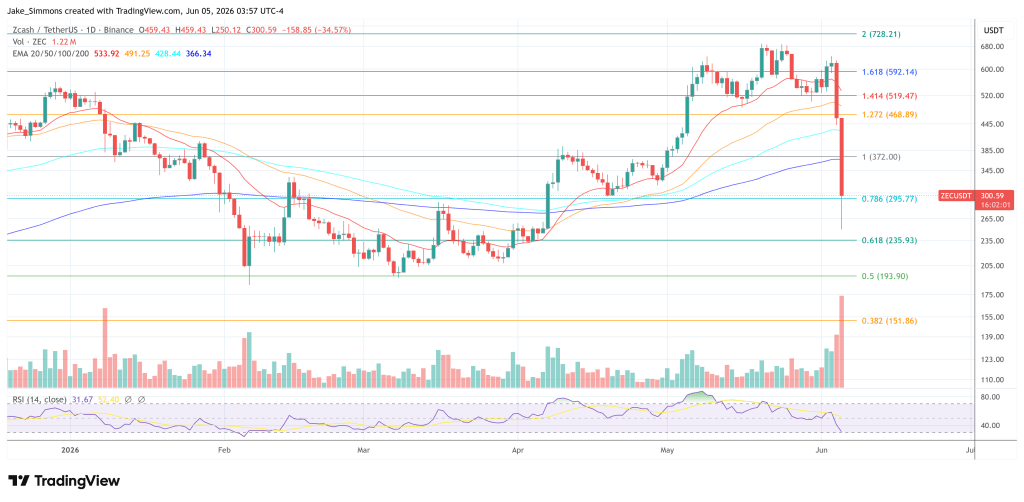
Featured image created with DALL.E, chart from TradingView.com