Wall Street bank JPMorgan and credit card giant Mastercard said they have completed the first cross-border, interbank redemption of a tokenized US Treasury fund, working with Ripple’s XRP Ledger and interbank settlement rails.
The pilot transaction involved blockchain tokenization platform Ondo Finance buying the US Ondo Short-Term US State Treasuries (OUSG) fund for Ripple on the XRP Ledger. Mastercard’s multi-token network then directed settlement instructions to JPMorgan’s blockchain platform, Kinexys, to deliver US dollars to Ripple’s bank account in Singapore.
“For the first time, public blockchain and global banking infrastructure have jointly settled a real-time cross-border tokenized fund transaction,” Ondo Finance he said Wednesday.
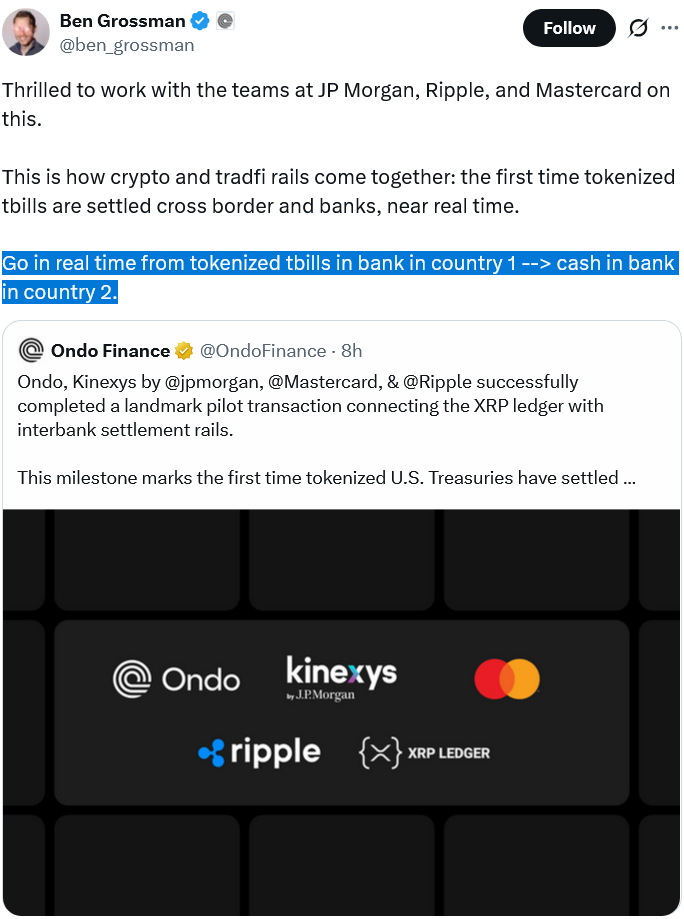
Source: Ben Grossman
The pilot reflects the growing collaboration between crypto companies and TradFi institutions looking to build faster, cheaper, global payment and settlement systems that work outside of traditional banking hours.
The pilot involving OUSG follows on from a previous one involving JPMorgan and Ondo Finance in May 2025, when a tokenized US Treasury fund moved via a public and permissioned blockchain network.
The tokenization of real-world assets has attracted increasing interest from Wall Street leaders, who envision the tokenization of everything from stocks and bonds to money market funds and real estate.
More than $31.1 billion worth of real-world assets, excluding stablecoins, are currently tokenized on the chain, according to RWA.xyz data. The Boston Consulting Group estimated in 2022 that the tokenization market could grow to $16 trillion by 2030, while McKinsey & Co. said it could reach a more conservative $2 trillion in the same time frame.
Related: Stablecoins act like FX markets when liquidity is shared: Eco CEO
The New York Stock Exchange’s parent company, Intercontinental Exchange, announced in January that it will launch a tokenization platform for 24/7 trading and instant settlement of stocks and exchange-traded funds using a post-trade blockchain system, marking one of the biggest developments in the tokenization space to date.
Tokenization needs regulation before widespread adoption
Despite the developments, the International Monetary Fund flagged several concerns in an April report, including that tokenization shifts risk from the banking system to shared ledgers and smart contracts, making it harder to intervene during “stress events.”
The IMF added that without legal clarity on ownership records and settlement finality, tokenized markets risk being “fragmented and peripheral”.
Shark Tank investor Kevin O’Leary raised this concern on Wednesday at Consensus Miami 2026, saying that significant capital will not be tokenized until crypto market structure legislation is passed in the US and complies with Securities and Exchange Commission rules.
“When that happens, everything will change,” O’Leary said at the conference.
Magazine: North Korea Denies Crypto Hackers, Upbit’s Bank Tests Ripple: Asia Express