
David Sacks Calls CFTC, SEC Select Crypto Regulation ‘Dream Team’
US President Donald Trump’s AI and crypto czar David Sacks has signaled that the White House may have what it takes to regulate digital assets following the confirmation of Michael Selig to chair the Commodity Futures Trading Commission.
In a Monday X post, David Sacks said the US is at a “critical crossroads” for crypto regulation, and that Selig and SEC Chairman Paul Atkins have assembled a “dream team to define clear regulatory guidelines.” Sacks’ comments were in response to Selig’s statement that the US Congress is preparing to finalize work on crypto market structure legislation.
“We are at a unique moment as a wide range of new technologies, products and platforms are emerging, retail participation in commodity markets is at an all-time high, and Congress is poised to send digital asset market structure legislation that will cement the US as the crypto capital of the world to the president’s desk,” Selig said at X.
Coinbase CEO Says GENIUS Act Relaunch Is ‘Red Line’, Criticizes Bank Lobbying
Coinbase CEO Brian Armstrong said any attempt to reopen the GENIUS Act would cross a “red line,” accusing banks of using political pressure to block competition from stablecoins and fintech platforms.
In a post on X on Sunday, Armstrong said he was “impressed” that banks could lobby Congress so openly without backlash, adding that Coinbase would continue to push efforts to revise the law. “We will not allow anyone to reopen GENIUS,” he wrote.
“My prediction is that the banks will actually turn around and lobby FOR the ability to pay interest and returns on stablecoins in a few years, once they realize the opportunity for them. So it’s 100% wasted effort on their part (besides being unethical),” Armstrong added.
The GENIUS Act, passed after months of negotiations, prohibits stablecoin issuers from paying interest directly, but allows platforms and third parties to offer rewards.
Bitcoin ‘never crossed’ $100k when adjusted for inflation, says Alex Thorn
Bitcoin is just shy of the six-figure milestone when inflation is factored in, despite the cryptocurrency hitting an all-time high of over $126,000 in October, according to Galaxy head of research Alex Thorn.
“If you adjust the price of Bitcoin for inflation using 2020 dollars, BTC has never gone above $100,000,” Thorn said on Tuesday. “It actually hit $99,848 in 2020 dollars, if you can believe it.”
Thorn said his adjusted high price for Bitcoin explained the decline in purchasing power of the Consumer Price Index (CPI) gradually through each inflation printout from 2020 to today.
The CPI measures inflation through the prices of a basket of goods and services and is calculated by the US Bureau of Labor Statistics to track changes in spending habits.

Widespread crypto ETF outflows show institutions pulling back: Glassnode
Bitcoin and ether exchange-traded funds have seen an extended streak of outflows, indicating that institutional investors have stopped using cryptocurrencies, analytics platform Glassnode said.
Since early November, the 30-day simple moving average of net flows into U.S. spot Bitcoin and Ether ETFs has turned negative, Glassnode said on Tuesday.
“This persistence suggests a phase of muted participation and partial disengagement from institutional allocators, reinforcing the broader liquidity squeeze in the crypto market,” it added.
Inflows into crypto ETFs tend to lag the spot markets for the tokens, which have been in decline since mid-October.
ETFs are also seen as leaders of institutional sentiment, which has been a market driver for most of this year, but appears to have turned bearish as the broader market declined.
A live Brazilian orchestra turns Bitcoin price movements into music
An experimental orchestral project in Brazil aims to turn Bitcoin price data into live music, after receiving approval to raise funds through one of the country’s tax incentive programs for cultural initiatives.
According to Brazil’s Federal Registry, the authorization allows the project to solicit up to 1.09 million reais ($197,000) from private companies and individual donors for an instrumental concert that uses financial data to create music, drawing on concepts from art, mathematics, economics and physics.
The publication does not specify whether any blockchain or onchain infrastructure will be used in the performance. The performance will take place in the capital of the country, Brasília.
Winners and losers
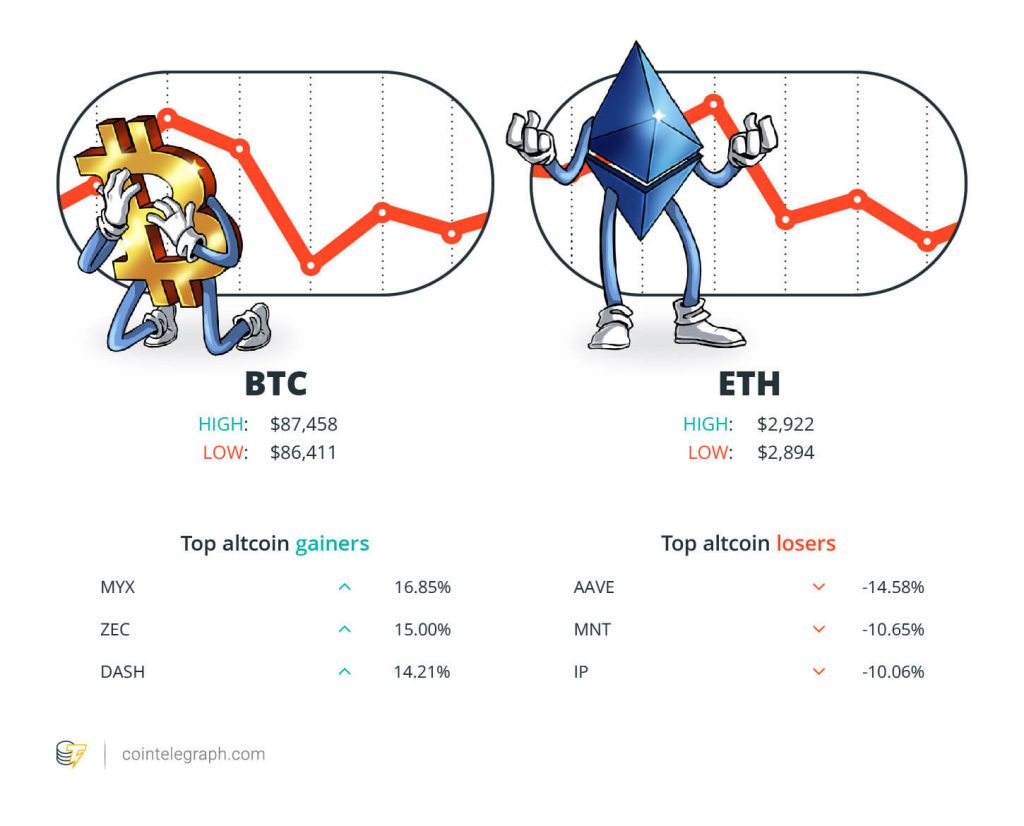
At the end of the week, Bitcoin (BTC) is 87,458 USD, Ether (ETH) to $2922 and XRP priced at $1.84. The total market capitalization is 2.96 trillion dollars, according to on CoinMarketCap.
Among the top 100 cryptocurrencies, the top three altcoin gainers of the week are MYX Finance (MYX) at 16.85%, ZCash (RABBIT) at 15.00% and Dash (DASH) to 14.21 percent.
The three biggest altcoin losers of the week are Aave (SPIRIT) at 14.58%, Plast (MNT) at 10.65% and Story (IP) to 10.06 percent. For more information on cryptocurrency prices, be sure to read Cointelegraph’s market analysis.
The most memorable quotes
“The market fundamentals this year for Bitcoin couldn’t be better.”
Phong LePresident of the Board for Strategy
“I want to see inflation fall to 2% without causing undue damage to the labor market. It’s a balancing act.”
John Williamspresident and CEO of the Federal Reserve Bank of New York
“If Bitcoin is indeed in a bear market, which it appears to be, it would be difficult for Ethereum to make headway there.”
Benjamin Cowencrypto analyst
“We are at a unique moment as a wide range of new technologies, products and platforms are emerging, retail participation in commodity markets is at an all-time high, and Congress is poised to send digital asset market structure legislation that will cement the US as the crypto capital of the world to the President’s desk.”
Michael Seligthe incoming chairman of the US CFTC
“Given where volatility is right now, it would be very surprising if Bitcoin’s volatility decreased drastically, and yet it could get a 70% or 80% drop.”
Anthony PomplianoBitcoin entrepreneur
“I’ve seen many situations where someone calls Grok expecting their crazy political beliefs to be confirmed, and Grok comes along and spoils them.”
Vitalik Buterinco-founder of Ethereum
Best prediction of the week
Bitcoin’s current setup looks like 2019, says Benjamin Cowen
As Bitcoin continues to underperform gold and major stock indexes, investors are increasingly wondering if this cycle is playing out differently than expected. In a new interview with analyst Benjamin Cowen, we explore why Bitcoin is lagging traditional markets and why the current setup could look remarkably similar in 2019.
Cowen points out that while stocks and gold react positively to expectations of future monetary easing, Bitcoin appears to be far more sensitive to actual liquidity conditions than optimism itself.
Read also
Features
Block by block: Blockchain technology is transforming the real estate market
Features
Ordinals have turned Bitcoin into a worse version of Ethereum: Can we fix it?
That difference, he explains, helps explain why BTC has struggled to gain momentum even as broader markets rise. According to Cowen, Bitcoin often requires a clearer macroeconomic catalyst before it can outperform, and that catalyst may not be in place yet.
A key topic of discussion is feeling. Unlike previous cycle peaks characterized by widespread enthusiasm and retail speculation, this market has been characterized by relative apathy.

Best FUD of the week
Memecoins go from Christmas cheer to cold reality, sinking 65% on the year
Memecoins are trading near year-end lows, marking a sharp reversal from the speculative peak reached on Christmas 2024.
Memecoins fell 65% for the year to a market cap of $35 billion on Dec. 19, their lowest level in 2025, according to CoinMarketCap. On Friday, they pared some losses, which grew to about $36 billion.
Read also
Features
Back to Ethereum: How Synthetix, Ronin and Celo saw the light
Features
Rushing the ‘last bastion’: angst and fury as NFTs seek high culture status
Last year, memecoins surged on Christmas Day, recording around $100 billion in value, according to CoinMarketCap data.
Trading volume in the memecoin sector fell along with its value, falling 72% over the year to $3.05 trillion, as retail cryptocurrency investment trends shifted away from highly speculative assets.
JPMorgan Freezes Accounts of Two Stablecoin Startups Amid Sanctions Concerns: Report
JPMorgan Chase has reportedly frozen bank accounts associated with two venture-backed stablecoin startups after identifying exposure to sanctioned and high-risk jurisdictions.
The accounts belonged to BlindPay and Kontigo, two Y Combinator-backed stablecoin startups that operate primarily across Latin America, according to a report by The Information. Both companies accessed JPMorgan’s banking services through Checkbook, a digital payments company that partners with major financial institutions.
According to the report, the freeze came after JPMorgan flagged business activities linked to Venezuela and other locations subject to US sanctions.

Aave founder denies buying tokens to influence failed DAO vote
Stani Kulechov, founder and CEO of Aave Labs, the lead development company behind the decentralized finance lending protocol Aave, has denied claims that he recently bought $15 million worth of Aave tokens to influence a controversial community vote that failed.
“These tokens were not used to vote on the recent proposal, and that was never my intention. This is my life’s work and I put my capital behind my conviction,” Kulechov said.
He also said that Aave Labs did not clearly communicate the economic alignment between it and Aave token holders. “In the future, we will be more clear about how the products built by Aave Labs create value for DAO and AAVE token holders,” he added.
Subscribe
The most compelling reads in blockchain. Delivery once a week.


Editorial office
Cointelegraph magazine writers and reporters contributed to this article.