
Solanine’s (SOL) market structure is entering a tense phase, shaped by reduced liquidity, increased leverage and conflicting signals in institutional flows and derivatives markets.
Related reading: Bitcoin’s current rally will end in a crash – here’s when to start selling
While price movements remain within familiar ranges, fundamental conditions paint a more complex picture, one that traders are watching closely for signs of either exhaustion or a sharp reversal.
In recent sessions, Solana has been trading between $128 and $145, with short bounces that have lifted it towards the upper end of this range. However, liquidity indicators suggest that a deeper reset is taking hold. Analysts note that these conditions often precede turning points, although they can increase volatility in the short term.
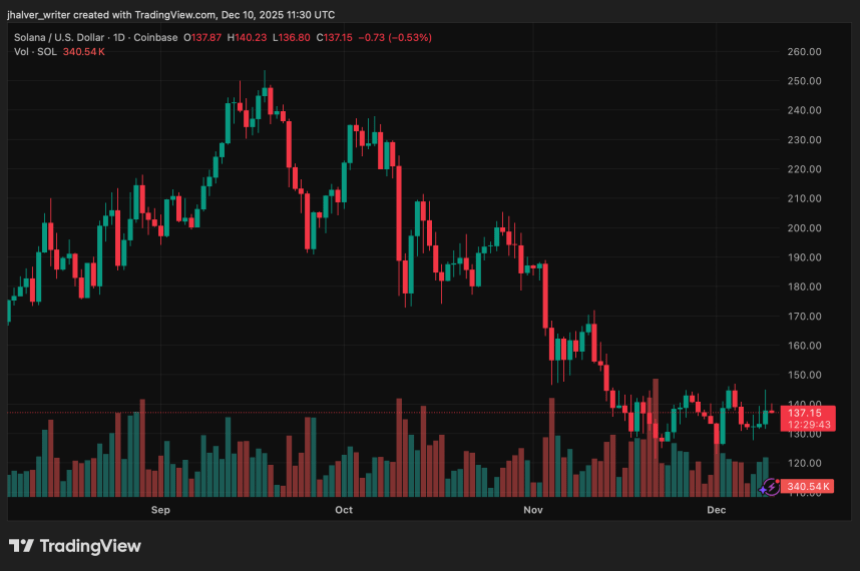
SOL's price trends to the downside on the daily chart. Source: SOLUSD on Tradingview
SOL liquidity falls to bear market levels
The data in the chain shows Solana’s 30-day the realized profit and loss ratio has remained below 1 since mid-November. This pattern, of more realized losses than gains, usually indicates a reduction in liquidity similar to historical bear market phases.
Analysts at Altcoin Vector describe the current setup as a “full liquidity reset,” a process that typically takes several weeks to resolve.
That backdrop is consistent with observations from SynFutures, whose team cites realized losses, falling futures open interest and fragmented liquidity pools as contributing factors.
Market makers have also retreated, thinning order books even as realized volatility increases. The effect is that the market is very sensitive to sharp moves, especially around key liquidation clusters.
Significant risk appears around the $129 level, where nearly $500 million in long positions would be liquidated if the price retests that zone. With $15.6 million of SOL contracts wiped out in the last 24 hours alone, the market remains susceptible to cascades.
Similarly, foreign exchange balances continue to fall, with spot ETFs bringing in more than $17 million this week, signaling accumulation despite broader stress.
Volatility increases as derivatives and spot activity diverge
Derivatives data reflects a cautious but engaged trading environment. Open interest climbed back above $7.2 billion, rising in tandem with a recovery in daily volume.
This type of build-up during a quiet price phase often signals positioning ahead of a larger move. Ratios of long and short have risen in recent days and funding rates remain positive, although traders are becoming more sensitive to macroeconomic catalysts.
Spot markets tell a different story. Liquidity is tight, and the deep reset cycle metrics indicate selling exhaustion rather than active expansion. This divergence, characterized by high derivative activity against weakening spot liquidity, usually precedes spikes in volatility.
Key Solana levels ahead as the market waits for a turn in the cycle
Technical, Saltworks remains stuck between established boundaries. The $145 resistance zone has capped multiple attempts to break higher, while support around $135 and deeper levels near $129 hold significance for traders monitoring liquidation risk.
The momentum indicators are stabilizing and the MACD is heading towards a potential positive crossover. Analysts note that past liquidity resets have been followed by rapid upward moves after conditions have improved; however, the timing remains uncertain.
Related reading: NFT decline worsens as monthly sales bottom out
Currently, Solana is at the center of a conflict between cautious sentiment, weakening liquidity and stable institutional flows. Whether these opposing forces translate into a recovery or further volatility may depend less on the price action itself and more on how quickly liquidity returns to the ecosystem.
Cover image from ChatGPT, SOLUSD chart from Tradingview