A recent commentary from the Kobeissi letter highlighted a worrying trend in capital markets: crypto-focused funds have run into significant outflowswith a significant $2 billion coming out last week alone.
This marks the most significant withdrawal since February and extends a worrying streak, bringing total outflows to $3.2 billion over the past three weeks.
Bitcoin and Ethereum are facing massive pullbacks
Leading these outflows is the market’s leading cryptocurrency, Bitcoin (BTC), which has seen massive withdrawals of $1.4 billion, while the second largest cryptocurrency, Ethereum (ETH), is right behind with $689 million.
As a result of this dynamic, the average daily outflows as a percentage of assets under management (AuM) have reached unprecedented levels.
Related reading
The cumulative effect of these outflows, along with falling prices, has led to a 27% decline in total assets under management, which now stand at $191 billion, a situation Kobeissi Letter has called a “structural decline.”
Market sentiment remains largely negative, especially for Bitcoin, and expert Lark Davis examines current trends through the lens of key moving averages.
Davis pointed out that as long as Bitcoin trades below the 50-week exponential moving average (EMA), which is currently just above the $10,000 mark, it remains in a bear market.
He questioned whether the current decline marks a “big bear”, hinting at skepticism about the prospects for a recovery, or a “small bear”, reminiscent of the decline in April where Bitcoin, despite losing the 200-day EMA, failed to break the 50-week EMA.
Davis suggested three possible scenarios for the coming weeks. The first assumes a drastic fall into the “goblin city” without recovery, which he considers unlikely given the current situation oversold conditions.
Another scenario involves a short-term rally that tests the 50-week EMA, potentially drawing investors back before a sharp decline.
A third scenario, which Davis leans toward, suggests Bitcoin could retrace its 50-week EMA by the end of the year, driven by easing macroeconomic conditions, including interest rates and market valuations.
Turmoil in the crypto market is intensifying
Further complicating these market concerns is the uncertain situation of Strategy, formerly known as MicroStrategy, which is run by Bitcoin advocate Michael Saylor.
Jacob King, CEO of SwanDesk, noticed if Bitcoin falls another few percentage points, specifically below Strategy’s average buy to just under $80,000, the company would find itself in a precarious position with its Bitcoin holdings.
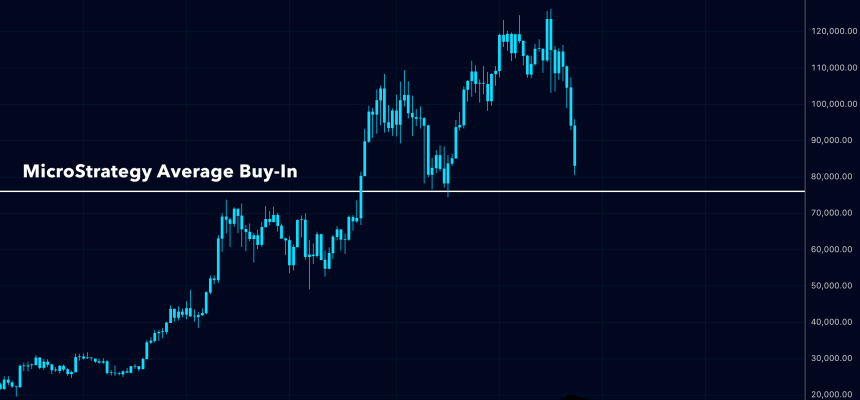
King fears that forced liquidations for crypto investors could occur again, which could lead Bitcoin prices to fall towards $10,000 or lower due to increased selling pressure.
Related reading
King’s comment reflects broader skepticism about the sustainability of the crypto market structure. He criticized the investment strategies surrounding Bitcoin as backed by “unsustainable fraud and hoppy.”
Highlighting Saylor’s past statements, King recalled when Saylor encouraged extreme measures—such as expulsion double mortgages and selling personal assets—to invest in Bitcoin, arguing that the current market turmoil should come as no surprise.
At the time of writing, Bitcoin was trading at $84,700, more than 30% below the all-time high of $126,000 reached earlier in October.
Featured image from DALL-E, chart from TradingView.com